
National Science and Technology Council Approves: Taiwan Perovskite Solar Corp Granted Access to Science Park

The National Science Council convened a Science Park Review Committee meeting yesterday (the 11th) and formally approved the "Taiwan Perovskite Technology Central Science Park Branch" to establish operations in the Central Science Park , with an investment of NT$15 million, with a focus on the development of perovskite solar modules and application products. This move not only signifies that Taiwan Perovskite Technology continues to advance toward mass production and field applications but also symbolizes that Taiwan is gradually establishing a complete industrial chain in the deployment of third-generation solar energy and new energy systems.
In recent years, with the rapid growth of AI, high-performance computing (HPC), smart factories, and IoT devices, the global energy demand is undergoing structural changes. Future energy systems will no longer be just large centralized power supply but will gradually move towards distributed, self-supply, and intelligent development. Perovskite technology has thus become a key focus of the global new energy industry. Compared to traditional silicon solar energy, Perovskite offers high efficiency, lightweight, flexibility, translucency, and low-light power generation, making it considered one of the important technologies for the third-generation solar energy and gradually extending to new application fields such as BIPV building integration, self-supply AIoT, indoor low-light energy, and smart buildings.
Four-dimensional advancement creates new energy solutions
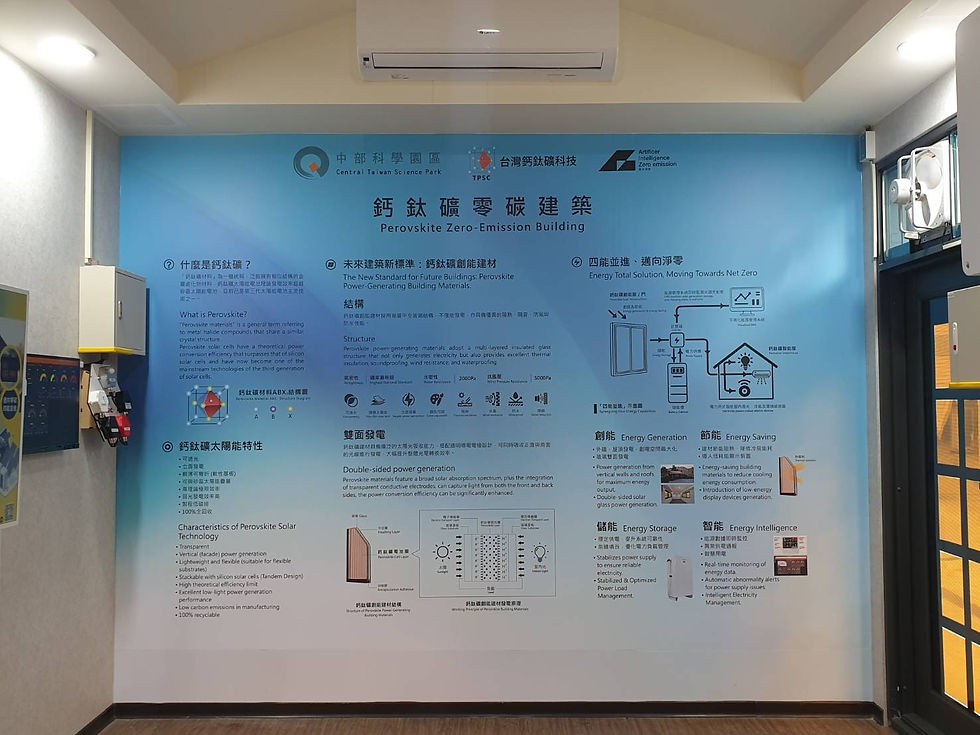
In recent years, Taiwan Perovskite Technology has continued to promote the concept of "four-pronged advancement," integrating power generation, energy storage, energy conservation, and smart technology to form a comprehensive new energy solution.
"Energy Generation": Centered on perovskite solar technology, energy-generating windows, and Building-Integrated Photovoltaics (BIPV), this initiative enables building facades, glass surfaces, and unused spaces to generate electricity, gradually transforming buildings from traditional energy consumers into energy production hubs.
"Energy Storage": Through energy storage equipment and energy dispatch systems, green electricity generated during the day is stored and managed to improve energy efficiency and self-sufficiency, while reducing peak electricity demand and grid strain.
"Energy Efficiency": By integrating the thermal insulation design of power-generating windows, an EMS energy management system, high-efficiency electrical equipment, and building energy-saving planning, we reduce energy consumption for air conditioning and the building as a whole. In particular, power-generating windows not only generate electricity but also reduce heat conduction and solar radiation from western exposure, further enhancing the building’s energy efficiency.
"Smart": Through an IoT, AI, and Edge AI-based energy management platform, we monitor power generation, electricity consumption, and equipment efficiency in real time, enabling intelligent energy dispatch and analysis, and gradually forming a new type of smart energy system that integrates AI and energy.
在全球淨零碳排與 ESG 趨勢持續升溫下,能源系統已不再只是單純供電設備,而開始與建築、AI、IoT 與智慧管理深度整合。台灣鈣鈦礦科技也正持續朝向材料、設備、模組、建築與能源管理整合方向推進。
Energy Window: From Power Generation to Building Energy Saving

In the four-dimensional integrated framework, the "Perovskite Solar Window" has also become one of the important technologies receiving attention in recent times. The Energy Window adopts perovskite semi-transparent technology and a multi-layer laminated safety glass structure, allowing architectural glass to not only allow daylight but also have power generation capabilities. In the past, glass curtain walls that could only consume energy will gradually transform into building energy systems with energy creation capabilities. However, the value of the Energy Window is not just in power generation, what is more important is "energy saving".
Creative Window introduces multi-layer glass and hollow insulation design, with thermal conductivity (U-value) below 2.7, effectively reducing heat transfer and west-facing solar radiation entering the room, further reducing air conditioning energy consumption. Especially in Taiwan's high-temperature, high-sunlight environment, building insulation capability will become a key factor in future energy conservation.
Additionally, the Energy Creation Window also features the ability to block part of UV ultraviolet rays, reduce noise interference, enhance indoor comfort, and integrate with architectural aesthetics, allowing buildings not just to be "energy-consuming bodies," but also to become part of the energy system at the same time.
Facades and Photovoltaics with BIPV: Chengdu's New Energy Direction
Future large-scale construction, public engineering, and urban renewal projects will have the opportunity to gradually introduce facade photovoltaics and BIPV systems. Compared to traditional rooftop solar, facade photovoltaics are more suitable for high-rise dense urban environments and can simultaneously achieve multiple functions such as power generation, thermal insulation, architectural design integration, and reducing building energy consumption. This also makes energy-generating windows and BIPV technology begin to become an important development direction for urban zero-carbon buildings. As the global demand for building zero-carbonization continues to increase, building-integrated energy systems will also gradually move from pilot areas to practical applications.
Currently, Taiwan perovskite solar corp. is also continuously promoting the "Perovskite Zero Carbon Building" demonstration area of National Central University, gradually linking materials, processes, equipment, modules, BIPV, and AIoT energy applications to form a complete energy application ecosystem, from energy-generating windows, self-powered AIoT, to facade photovoltaics and zero-carbon buildings, calcium-titanium mine technology is gradually changing the form of energy.
In the future, when every piece of glass can generate electricity while also reducing building energy consumption; when every building can participate in energy management, the energy system will gradually shift from centralized power supply to decentralized, smart, and localized systems. And Taiwan Perovskite Solar Corp. will also continue to promote the development of perovskite technology and new energy applications.
References
【Latest Event Information】

Event Date: 115/07/24 (Fri) 09:30-17:30 (09:00 onwards entry begins)
Location: Academia Sinica South Campus International Conference Hall (No. 100, Section 1, Guiren 13th Road, Guiren District, Tainan City)
Forum Features: Application of Four Core Themes, 3 Main Theme Sessions, 17 Special Lectures, Inviting Domestic and International Experts to Share
Organizers: Taiwan Calcium Carbonate Research and Industry Alliance, Academia Sinica Key Issues Research Center
Co-hosts: Taiwan Perovskite Solar Corp., SEMI International Semiconductor Industry Association, AUO, National Cheng Kung University Department of Photonics and Optoelectronic Engineering
🔍 Learn more: Click here

Recent popular articles:


Comments